
_edited.png)
Inside the “Willow World”: A Ballet Dancer’s View of Kyoto Geisha Culture
- Zen Gaijin

- Aug 19, 2025
- 11 min read
Updated: Mar 29
Part 1
Author's Note: This exploration of Kyoto's geisha culture is presented in two parts. Part 1 examines the artistry and cultural depth of the "willow world" through the eyes of a professional ballet dancer. Part 2 provides practical guidance on where and how to experience authentic geisha culture respectfully—and what tourist experiences to avoid.
When I first stepped onto a Kyoto stage beside my friend, a young maiko in her brilliant yellow kimono, I realized how deeply the world of the Kyoto geisha resonated with my own journey as a classically-trained ballet dancer. We share the same dedication, discipline, and quiet pride in an art form that demands years — even decades — to master.

The author celebrates the excellent dance performed by her maiko friend.
I love geisha and the world they inhabit because we share the same soul. I also love them because, in large measure, we have shared the same life.
In Japanese culture, the “willow world” — karyūkai in Japanese — refers to the mysterious, achingly beautiful, and enormously demanding realm of the geisha--known in Kyoto as geiko-- and the apprentice geisha known as maiko.
My fascination with this world comes from recognizing in their path the same daunting climb I once faced in ballet — from a shopping center ballet school in Houston to becoming a Principal Dancer for a major company — a journey that is as much a way of life as it is a profession.

Like aspiring geisha over centuries, I immersed myself in an esoteric culture that took me away from conventional career paths. I paid my dues and lived in tight quarters with other dancers for years. I spent countless hours mastering a demanding set of skills, learning how to make technique look transcendent. Endlessly, I practiced a repertoire of precise movements, striving for ever-greater skill, subtlety and expression. I learned the history of my art, the culture of my craft. And as many fledgling dancers gave up and dropped out, I persevered and climbed step by step up a challenging hierarchy.
To become a geisha is a triumph, and I know that feeling.
A Performer’s Eye: What I See When Kyoto Geisha Perform
What strikes me most when watching geiko and maiko perform is something most audiences fail to appreciate: they're achieving artistic precision while their movement is constrained by their clothing. In ballet, costumes are designed for movement—stretchy fabrics, strategic cuts, everything engineered to enhance rather than restrict our bodies. Geiko perform in layers of heavy, restrictive undergarments beneath elaborate kimono that can weigh up to 45 pounds.


In the hands of skilled dressers, otokoshi, layer after layer transforms fabric into tradition—an intricate, weighty embrace that shapes both posture and presence.
Yet within these constraints, geiko and maiko achieve something I recognize as extraordinary: absolute precision in every movement. Not just the obvious ones—the dance steps, the shamisen playing—but the minute details that separate artistry from mere technique. The exact angle of a head tilt, the precise positioning of fingers on a fan, the controlled speed of an eye movement during conversation. Each gesture must be executed flawlessly within the narrow confines of their clothing.

Most tourists see the visual spectacle and think "my, how pretty." But I see athletes performing in weighted training gear, artists who've learned to make severe limitation look like infinite grace. When a maiko serves tea in that elaborate kimono, maintaining perfect posture and fluid movement, I'm watching someone perform what amounts to an athletic feat disguised as hospitality.

The breathing control alone is amazing. Corseted by layers of fabric and obi, they must control their breath for singing, playing instruments, and maintaining that serene expression—all while their ribcage is tightly bound.
Notice how a maiko distributes her weight as she performs in those towering okobo sandals, requiring the same kind of balance and core engagement I used en pointe.
But here's what separates true artistry from mere technical execution: like ballet, geiko must achieve excellence in the exacting discipline AND add their personal interpretation to that precision. It's not enough to execute a tea ceremony or a challenging Karyukai dance with perfect technique—if you want to be at the top of the profession, you must bring your unique grace and interpretation to every performance.

When I watch a performance, I notice and respect the flawless precision, but it's that extra something—that individual artistry—that draws me to certain performers. On top of years of demanding training, endless rehearsals, grueling schedules, and those restrictive layers of silk, every geiko brings a piece of their uniqueness to their work. That's what transforms technical mastery into art.
This is why most geisha tourist experiences miss the mark. They reduce centuries of artistic evolution to grab-and-go shows, focusing on the costumes and makeup while ignoring both the extraordinary physical discipline and the individual artistry underneath all that silk.
A Rich Historical Tradition...and a Dying Art Form
The dismissive attitudes about geisha I so often hear break my heart because I know what this level of dedication costs. When tourists treat geiko as "mincy mannequins in whiteface" or "kimono models," they're dismissing something I recognize as profound: the choice to dedicate one’s entire life to preserving an art form, knowing that much of the world may not understand or value what you do.

Today the willow world is dying. From 80,000 geisha across Japan a century ago, fewer than 1,000 remain, clustered in Tokyo, Kanazawa, and Kyoto's five remaining hanamachi ("flower towns"). As someone who has watched classical ballet struggle for relevance and funding, I see the same cultural erosion happening here—but in Japan it is accelerated by tourism that treats artists as photo opportunities rather than masters of their craft.
A Guided Tour of the Geisha World
Origins of Geisha Culture
The geisha profession emerged in 17th-century Kyoto from tea houses where young women developed what evolved into the elaborate tea ceremony. Like the evolution of ballet from court entertainment to high art, geisha culture expanded from this foundation into a comprehensive artistic discipline embracing music, dance, singing, acting, conversation, and gracious hospitality.

To me, what is most striking about this history is how strongly it mirrors ballet's development—the same progression from entertainment to art, the same struggle for respect and recognition.
Today's Reality: The Numbers Tell the Story
Kyoto’s geiko community now consists of approximately one hundred geiko and a similar number of maiko. This decline represents more than numbers—it reflects a contraction in the transmission of highly specialized, embodied knowledge. While arts such as ballet are extensively documented through notation, video, and pedagogy, the karyūkai relies far more heavily on direct, sustained mentorship. When a geiko retires without training a successor, the form endures, but layers of interpretation, refinement, and lived understanding may not.

These surviving artists continue preserving traditions that would otherwise vanish: shamisen music, kyomai dance, tea ceremony, and ikebana (flower arranging). They're like the last keepers—living libraries of technique and culture.
The Okiya System: Where Art Meets Business
Okiya are the geisha houses where all artists must be registered. The okiya system fascinates me because it parallels aspects of major ballet companies while being uniquely Japanese. Usually supervised by oka-san ("Mother"), often former geiko themselves, okiya function simultaneously as homes, training academies, talent agencies, and business enterprises.

The okiya of Kyoto are grouped among five hanamachi. Think of hanamachi as intimate neighborhoods embracing scores of okiya (houses) each displaying distinctive paper lanterns adorned with symbols such as interconnected dango (dumplings)--like the interconnected hanamachi.

What I recognize from the ballet world:
Territorial competition between hanamachi, much like the rivalries between ballet companies.
Senior artists mentoring juniors while competing for the best roles.
Constant pressure to maintain artistic standards while managing commercial realities.
Okiya maintaining complete control over performers’ professional lives.
What's uniquely geisha: The oka-san must fulfill many different roles: talent scout, artist manager, fund raiser, landlord, trainer, surrogate mother, and cultural preservationist. She fosters distinctive styles for her artists while competing with other houses for prestige and market dominance. The financial stakes are enormous—she deals daily with tour operators, hotels, corporate schedulers, individual clients, suppliers for all the okiya’s needs, all while preserving centuries-old traditions.

Entering the Willow World
When a young woman aged between fifteen and twenty passes rigorous screening and becomes a maiko in an okiya, she undergoes complete transformation: new home, new family, new oka-san, new profession, new skills, even a new name. She enters a world of cultural tradition, rigid hierarchy, regimented daily life, performance artistry—and high-stakes business competition.
The Sister System: A Bond Deeper Than Mentorship
Sisterhood and family are fundamental to Kyoto geiko society. Each new maiko becomes the "younger sister" of an experienced geiko, creating a complementary partnership that lasts throughout her journey.

This bond begins with sansan-kudo—"the tying together of destinies"—a sake ceremony using the same ritual language as Japanese marriages. The older sister becomes responsible for rigorous instruction, while the younger receives a name connecting her to both the okiya's lineage and her sister's identity. If the mentor is named Ichiume, for example, the maiko will have "ichi" in her new name.
This sisterhood creates something I deeply admire and frankly envy as a former ballet dancer: genuine investment in each other's success. When the maiko succeeds, the older sister succeeds too—their fates truly are intertwined. There's no formal corollary in the ballet world, and I wish there were.

In ballet, a young dancer may find a teacher who advocates for them, but this is nothing like the steady, nurturing hand that's always there to support and guide the maiko through every challenge. The path for most ballet dancers is far lonelier. This mutual assistance to attain shared success is quintessentially Japanese, and it's one of the most beautiful aspects of geiko culture.

The five Kyoto districts (gokagai) are: Gion Kobu, Gion Higashi, Ponto-chō, Miyagawa-chō, and Kamishichiken. Geiko typically tend to work within their own hanamachi unless hired for special performances. Geiko engagements not held in licensed restaurants, teahouses or a geiko’s own hanamachi are called “tode” (“distant outings”).
From Maiko to Geiko: The Artistic Journey
The progression from maiko to geiko takes five to six years of rigorous training—not dissimilar to the time it could take to advance from corps de ballet to principal. But unlike ballet, where dancers often peak in their twenties, geiko reach their artistic prime in their thirties and forties, when life experience deepens their maturity, skills, and performance presence.

Distinguishing geiko from maiko: There are notable differences in attire and makeup between the two:
Maiko (ages 15-20): Think of Kyoto Maiko as corps de ballet dancers—technically skilled but still learning to inhabit their artistry. Their elaborate appearance compensates for what they haven't yet developed in subtlety and presence.
Kimono: More ornate and colorful with long sleeves and red collars—like a young dancer who needs flashier costumes to command attention. Maiko wear a longer and more elaborate obi called a darari obi, which hands almost to her feet. The nagajuban is an underkimono layer that Maiko and Geiko wear. Maiko always wear a red nagajuban with a white, seasonal pattern on it. You can see it at the edge of their sleeves and around their lower legs when they walk.
Makeup: Red lipstick only on the lower lip during the first year—a mark of apprenticeship as clear as a corps dancer's position in the back row
Hair: Must maintain elaborate hairstyles using their own hair, requiring them to sleep on uncomfortable pillows called takamakura. They wear elaborate, dangling, colorful hair ornaments.
Footwear: Tall, precarious okobo sandals, sometimes with bells.

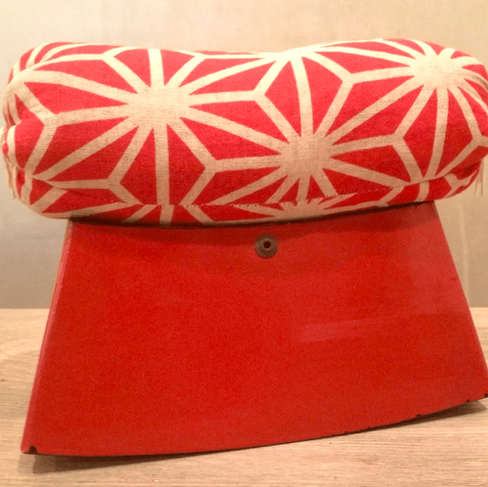

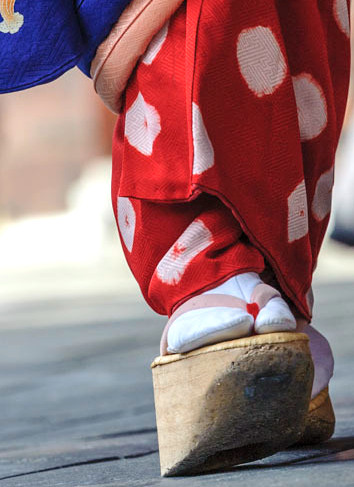
Left: A takamakura, or high pillow, supports the neck allowing maiko to maintain the intricate hairstyles overnight without damage. Right: Red silk nagajuban of a maiko can be seen as she walks in her okobo and holds her kimono up to keep it clean.
Geiko (typically 20+): These are much like the principal ballet dancers—artists who've learned to make their sophisticated appearance look effortless.
Kimono: Simpler designs with shorter sleeves and white collars—like how principal dancers can command the stage in the simplest costumes. Geisha wear a short, less flamboyant obi that is compact. Geiko also wear nagajuban, usually in light colors, but for formal occasions, they must wear a red nagajuban.
Makeup: Red lipstick on both lips and simpler overall makeup application—reflecting confidence that doesn't need elaborate decoration.
Hair: Wigs, allowing more comfortable sleep—a practical choice that comes with seniority, like principals getting better dressing rooms. Geiko wear few hair ornaments.
Footwear: Shorter zori or geta sandals—stable, practical, elegant.


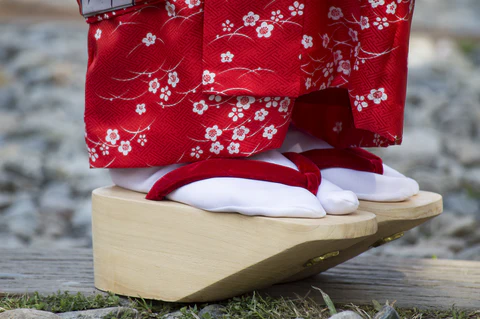


From left to right: Maiko with elaborate hairstyle and makeup versus the more understated geiko; maiko’s long darari obi contrasted with a geiko’s shorter obi; tall wooden okobo sandals of a maiko beside the lower, practical geta worn by geiko.
A crucial insight: By the time they become geiko, these artists distinguish themselves through their presence, as well as their musical skills, and gracious hospitality abilities—just as principal dancers are chosen not just for technique, but for their ability to inhabit a role completely.
The Geiko Career Path
The careers of geiko and maiko are defined by strict rules of social conduct. While a well-known and highly-respected geiko may be supported by a patron or even a patron organization, they are expected to avoid romantic relationships (at least visible ones). Traditionally, geiko are not allowed to marry or have boyfriends while actively working as a geiko for an okiya. If a geiko chooses to marry, she must leave the profession and relinquish her geiko name. The rules are even stricter for maiko, who may not have boyfriends and whose contact with the outside world is severely restricted.

The willow world remains steadfastly traditional. After a postwar period during which geisha experimented with Western-style clothing and entertainment, the profession has returned to practicing and protecting traditional arts and aesthetics.
Many geiko opt to retire in their thirties or forties, leaving their okiya, marrying, and transitioning into roles as wives and homemakers. Today, the average age of a geiko in Gion is roughly 39, with the vast majority being aged 35 to 49. For those determined to continue in the profession, a common path involves becoming an okiya owner or inheriting the okiya they have long been affiliated with, taking on the all responsibilities of running a geisha house and guiding its business activities.
A point worth noting is what geiko and maiko are not: prostitutes. Although the first woman known to have called herself a geisha in 1751 was in fact a prostitute, today in Japan geisha are forbidden under the Prostitution Act of 1956 from selling sex, an activity reserved for a separate profession, courtesans. Today, a geisha’s sex life is her own private affair.

Appreciation of the artistry and cultural significance of geiko is essential before seeking authentic encounters. Like the lanterns of Pontocho, their tradition casts a glow on Kyoto’s cultural soul. In Part 2 of this post, we’ll explore which performance experiences honor this heritage—and which miss the point.
The geisha information in this piece draws both from my time living in Japan and from a variety of sources, some of the best of which are listed below.
Sources:
Dalby, Liza. Geisha. Berkeley: University of California Press, 2008. ISBN 978-0-520-25789-4.
Gallagher, John. Geisha. London: PRC Publishing Ltd., 2003. ISBN 1-85648-697-4.


