
_edited.png)
Guardian of Everything: Traveling with an ADHD Partner
- Zen Gaijin

- Jun 27
- 9 min read
Updated: 5 days ago

My husband lost his boarding pass between the security checkpoint and the First Class lounge.
Not between the gate and the plane. Not somewhere in the terminal labyrinth between Concourse A and Concourse G. No, he misplaced it between the security checkpoint and the lounge. A distance measurable in steps. A boarding pass that existed in his hands at one moment and vanished into the ether in the next.
I have been traveling with Doug for many years. I was not surprised.
I was, accordingly, the person who produced a replacement, because I have learned to carry a spare.
If you travel with someone you love who has ADHD, you already know exactly what I mean. You probably also just laughed that special laugh — one simultaneously exasperated and deeply fond, the one that resonates with that little internal voice: Here we go again.
For all such travelers, this post is for you.

This post is not a lament. It is not a cautionary tale. And it certainly is not a suggestion that you leave your ADHD partner at home while you travel in serene, organized solitude. It is intended to help preserve your sanity.
My husband is a Harvard Law graduate, a former federal prosecutor, Dow Jones columnist and now the author of award-winning thriller novels. His brain operates at a level most of us can only aspire to. Traveling with Doug is invariably an adventure, and I say this without a hint of irony. His enthusiasm for new places and experiences is boundless and genuine. His thirst for novelty has led to some of our most extraordinary moments in Japan and beyond.

And, it must be said, his lapses in focus, planning, organization and memory can be frustrating. I've learned the hard way that he just cannot be trusted with the passport. Or the boarding pass. Or the room key. Or sometimes his wallet. Or, memorably, an expensive pair of headphones somehow misplaced on a flight to Australia.
We will get to that.
What ADHD is and What it Does
ADHD is a disorder that affects the brain's ability to regulate attention, impulses and activity levels. It is not a sign of inconsideration or lack of intelligence. Rather, it is a neurodevelopmental condition that impacts daily life. It's permanent and you don't outgrow it. But, you can learn to manage it. Mostly.
Doug confirms that people with ADHD don't enjoy having it, both for the frustration it causes and the judgment of others who assume their lapses are deliberate.
Because they experience so much criticism and disdain growing up, many people with ADHD also suffer diminished self-esteem and chronic anxiety issues. They have learned that "if nothing's gone wrong yet, it's just about to." Furthermore, as Doug puts it, "It's not a lot of fun going through life being labeled as someone with both a deficit and a disorder."
A practical note: if you or your travel partner take ADHD medication, check Japan's import rules. Some common medications, including Adderall, are prohibited or require advance permission. Our guide to bringing medication into Japan walks through how to check your medication and, if needed, apply for advance permission.
An Infrastructure I Never Planned to Build
I am thinking about getting a hat made.
It will say: Guardian of Everything.

Anyone who travels with an ADHD partner will know exactly what it means. They will probably want one too.
As a result of Doug's unpredictable lapses, it's true: I have become the Guardian of Everything.
This role evolved incrementally, the way all practical systems do: one lost item at a time, one recovered wallet at a time, one heart-stopping moment at Australian customs.
Here is what the Guardian of Everything actually does:
The passports live with me. Doug receives his at the security checkpoint and returns it immediately upon clearing. This is not a reflection of my trust in him as a human being. This is evidence-based risk management, established after an incident we do not need to discuss in detail here.
The TGV tickets in France? On my phone only. Not on his phone, because his phone is also a variable. The Japan Web entry documentation? On my phone AND in paper backup, because even digital has failure modes. Hotel confirmations, car rental agreements, restaurant reservations, visa documentation, our complete itinerary — digital and paper, always both, always with me.

I carry a small collapsible travel valet tray that I place on Doug’s nightstand upon arrival at every hotel. I establish, out loud, upon check-in, that this tray is the home for his glasses, his hearing aids, his watch, and his wallet. I place the room key, actually both room keys, in a glass by the door. I say, out loud: "this is where the keys live. Every time we leave the room. Every time we return." (Note: this "out loud" behavior is important because it imparts a different and additional kind of memory trace for the ADHDer. Saying it out loud twice--without irony, anger or impatience--is a reinforcing safeguard.)
Here is what changed the way I think about it: travel disrupts the environmental cues that make normal functioning possible. When we're back at home, Doug has places for things. Systems, even if they are invisible ones. His watch goes somewhere. The wallet goes somewhere else. The habits carve deep grooves through repetition and familiarity.
In a new hotel room in Kyoto, none of those cues exist. Everything is unfamiliar. Everything is stimulating and interesting and new, and also foreign. And so, unless organizing "regulations" are agreed upon by both of us, the watch is likely to go somewhere different every night, the wallet migrates from pocket to to pouch to desk, and the room key achieves a kind of quantum state in which it exists everywhere and nowhere simultaneously. A kind of Schrödinger's key.
When the System Fails Anyway
I need to tell you about the headphones.

We were on our way to Australia. Doug had just acquired a new and rather expensive pair of headphones. They made the flight with him. They did not make it through customs with him. We discovered this after clearing customs, which, if you have ever cleared Australian customs, you know means there is no going back. No retracing steps. No quick dash to the gate.
We spent the first hours of our trip at the airport filling out forms. Making calls. Explaining the situation to a succession of patient, sympathetic, and ultimately unhelpful airline representatives. The headphones were never recovered. By us, at least. Obviously, someone on that plane found them. I hope they enjoy using them.
Not every misadventure ends this way — as two experiences in Japan show.
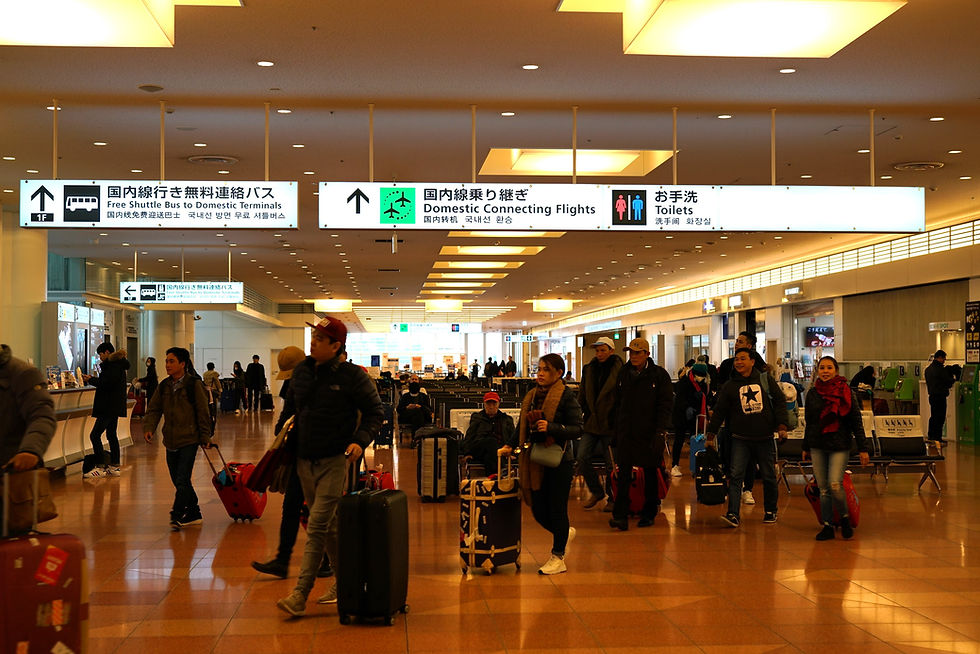
Upon arriving in Japan, Doug thought he had lost his wallet on the plane. Cash, cards, everything. We searched ourselves and our luggage. Nothing. When we contacted lost and found at Haneda, the folks at Japan Airlines could not have been more helpful. Our incoming plane was scheduled for a fast turnaround, so a gate agent rushed out to the airplane, armed with Doug's seat number. No go, it was not in his reclining seat, seat pockets or overhead storage.
Then, as Doug puts it, "Light dawned on Marblehead." He could not recall packing his wallet. We called a friend and asked her to search our home. The call soon came back: Doug had left his wallet on the dashboard of his car.
Unfortunately, we had experienced a similar debacle once before: arrived in Japan, Doug reached for his wallet, experienced that terrible sinking feeling. When we contacted lost and found, we learned that a Japan Airlines employee had found it, turned it in, carefully counted the cash and catalogued every card. When we arrived to collect it, the attendant recounted everything in front of us, item by item.
Nothing was missing. Not a single yen.
Yes, we lost some time. We had to bypass something on our itinerary. We had a happy ending, a true testimonial to human nature, Japanese human nature.
The Part Nobody Talks About
When something goes wrong — and if you travel with an ADHD partner, something will go wrong, and making peace with that reality in advance is itself a form of wisdom — there are actually two problems to solve simultaneously.
First, there is the problem itself. The lost wallet. The missing boarding pass. The headphones somewhere over the Pacific.
And, second, there is one's relationship with the person who lost the thing.
Because that person feels terrible: embarrassed, frustrated with themselves, watching your face for signs of how bad this actually is. And you — the Guardian of Everything, who has been managing eleventy-billion details since before you left the house, who just wants one thing, one single thing, to go smoothly — are now required to solve the logistical problem AND provide emotional support AND manage your own legitimate feelings AND project a calm you may not entirely feel.
All of this, frequently, while jet lagged. In a foreign country. Possibly in a language you do not speak.

I will not pretend I have always managed this gracefully. I have not. There have been sharp words and much-regretted sentences. Moments when the event led to exchanges that were neither productive nor pretty. I have improved at handling these situations, but still have further to go.
But I want to tell you about a conversation that changed things more than any system I have ever built.
Doug told me, during one of our pre-trip discussions about how to make travel work for both of us, that when something goes wrong, my facial expression looks like I am disgusted with him.
This surprised me: I did not know I was doing that.
Actually, I was not feeling disgusted. I was feeling focused — already three steps into problem-solving mode, already calculating what to do next. But that is not what he saw. What he saw was a face he expected to see, one he had witnessed often in his life, one that expressed disdain, disappointment, or worse. And he had been carrying that for a long time before he finally said it out loud.
I'm careful to use a different facial response now. Consciously, I've learned to employ a new one, a more neutral one, because someone I love told me something true and I wanted to do better.
The Rules That Make It Work
The goal is not a perfect trip. The goal is to come home still loving each other, with at least most of your belongings, having seen something that took your breath away and experienced things that bathed you in delight.
Accept, before you leave home, that there will likely be an incident. Budget for it emotionally. When it arrives, you will be tired and the gap between the trip you planned and the trip you are having will feel enormous. Having already made room for this possibility does not make it easy. But it makes it survivable, and with a little grace, it keeps you from saying the thing you cannot take back.
Have the hard conversations before you go. What works. What doesn’t. What your face looks like when you are problem-solving. What it feels like to be the one who keeps losing things, which is its own specific exhaustion and shame that the Guardian of Everything may not always be sensitive to. You can only reach this kind of constructive resolution if you have the conversation. And then have it again. I suggest you have it before every trip, adjusting and improving and being honest.
Here is the truth that took me a long time to fully understand: being the ADHD partner is inherently stressful. And being the Guardian of Everything is inherently stressful. Both people are carrying something real. Neither has the easier job.
Now, as for me, on the practical side of things, we have one inviolable rule in our traveling life: Do not touch Pam’s things.
Not her cords. Not her papers. Not her medicine bag. Not her credit cards. Not her carefully organized travel pouch with its labeled contents and its little card listing exactly what belongs inside. Let sleeping Guardians of Everything lie.

If you need something, you ask. Because if you ask, I will remember to get the credit card back after the konbini run. If you simply take it, it enters the quantum zone where room keys and boarding passes go, and will never be seen again.
Beyond that rule, here are some tactics I find that actually work:
Build "homes" for things immediately upon arrival. The valet tray. The key cup by the door. Say it out loud. Make it a ritual.
Go digital for everything you can, and keep it on your phone, not theirs. Paper backup everything anyway.
Let me be the last person to leave the room. Always. While Doug deals with the taxi, the luggage, the next destination, I do a final sweep. Every drawer opened. Every shelf checked. The safe deposit box. Under the bed. Behind the bathroom door. The charging cable still plugged into the wall.

Being the Guardian has also taught me something I did not expect: to savor. Because we will deal with disruption and tense moments on every trip, I have learned — and savor is exactly the right word — to swim out of the bustling current to the bank and simply be still. To notice and savor the morning light through a shoji screen. To sit with the sheer wonder of where we are and who we are together, before the river picks us up again.


