
_edited.png)
Japan Luggage Delivery Services: What Insiders Know
- Zen Gaijin

- Apr 26
- 10 min read

Hands-Free in Japan: The Complete Guide to Luggage Delivery
Let us be direct about where we stand: when Doug and I travel to Japan, we go light; it's carry-on only. I have lived and worked in Tokyo. I know its train stations well, and I am definitely not about to drag oversized luggage through them.
But I confess that I have not always traveled light. I've spent enough years traveling to Japan on business, attending extended education programs, and shepherding my family's collective mountain of suitcases through Japanese airports to know when luggage delivery services move from "nice option" to "trip saver." You want your bags to disappear and reappear at your hotel.
The One Thing Most Travel Articles Get Wrong

Japan’s airport-to-hotel luggage delivery services — takuhaibin forwarding, in the local parlance — are uniformly excellent. You hand over your bags at the airport, board your train without breaking a sweat, and find your suitcases at your hotel front desk that evening. In a country that executes logistics with almost religious precision, the system works superbly.
What most travel articles won’t tell you: same-day delivery has a cutoff time, and if your flight lands in the late afternoon — as many flights from the U.S. do — you may already have missed your shot at takuhaibin service. Every service listed below has its own window. You should know yours before you land.
At Haneda and Narita: Choosing Your Service

Airporter is geared specifically to international visitors — English-language booking, no counter paperwork, online payment in advance. It covers Tokyo (Haneda, Narita, and Tokyo Station), Osaka/Kyoto, Okinawa, and Sapporo, making it the most geographically broad service on this list. For same-day airport-to-hotel delivery, bags must be dropped at the airport counter by approximately 1:00 PM, with hotel delivery typically after 8:00 PM.
Pricing is per piece of luggage. For Haneda arrivals: carry-on size with length, width and height adding up to 120cm or less: ¥1,500; checked luggage size (up to 160cm): ¥2,000; oversized (up to 180cm): ¥3,500. Narita runs slightly higher — ¥2,000 / ¥2,500 / ¥4,000.

One Airporter capability is worth flagging for multi-city travelers: the service offers hotel-to-hotel delivery between Tokyo and Kyoto for ¥4,000 / ¥4,500 / ¥6,000 per piece depending on size. That is premium pricing, to be sure, but for a traveler who wants to send bags ahead to Kyoto while spending a final morning in Tokyo without having to rent a station locker, it is an attractive option. More on this comparison when we get to Kyoto.
If your flight lands before lunch, Airporter is seamless. If your flight touches down at 4:00 PM, same-day is gone. Them’s the breaks.
Yamato Transport — the black cat — is Japan’s backbone logistics system. You already know its famous logo.

What many experienced travelers don’t realize is that Yamato at Haneda operates a separate same-day delivery counter that is entirely different from standard next-day forwarding. Most people use regular takuhaibin and then wonder why “Yamato doesn’t do same-day.” They’re at the wrong counter. The same-day cutoff is around 10:30–11:00 AM — earlier than anything else on this list, which makes it the most time-sensitive option of the group. If you land early and find that counter, it works beautifully.
JAL ABC operates prominently at both Haneda and Narita with a cutoff of around 2:00 PM — more forgiving than Yamato, and particularly useful for late-morning arrivals. Walk off the plane, find the counter, hand over your bags, and walk out of there.
The Cutoff Times That Change Everything
ecbo/KEIKYU at Haneda Terminal 3 is the one many people miss entirely, and it has quietly become the most flexible arrival-day option at Haneda. The counter is on the 2nd floor of Haneda Terminal 3 Station, at the back of the KEIKYU TIC counter. Business hours run 7:00 AM to 5:00 PM.

Wait, we’re not done. The complete ecbo/KEIKYU picture is more nuanced than a simple cutoff time — and here’s where it pays to know the details.
If you drop your bags at the ecbo/KEIKYU Delivery Counter by 1:00 PM, you pay standard rates. Drop them between 1:00 PM and 4:00 PM and the service still runs, but a modest ¥500 overtime surcharge applies per bag. So your real decision is whether you want standard pricing or are willing to pay a slight premium for the extended window.
Standard ecbo/KEIKYU pricing:
• Small (up to 120cm total dimensions): ¥1,500
• Large (up to 160cm): ¥2,000
• Oversized (over 160cm): ¥3,000
After 1:00 PM, add ¥500 to each.
ecbo/KEIKYU delivery covers Tokyo’s 23 wards, Kanagawa (Kawasaki), and Chiba (Urayasu). And if you’re taking the Keikyu Line into the city — a perfectly sensible choice from Haneda — present your train ticket at the counter for a ¥500 discount off your delivery fee. A small thing maybe, and very Japan.
The Departure-Day Angle Nobody Writes About
Here is the development that genuinely excites us, because it solves a problem travelers returning home know intimately: what to do with your luggage on your last day in Tokyo.
As of early 2026, KEIKYU, ecbo, and Vision have launched a trial that runs the service in reverse — from central Tokyo locations directly to Haneda Airport. Drop your bags in the morning at one of three city locations (ecbo cloak Marunouchi, TIME SHARING Shimbashi, or Keikyu EX Inn Nihombashi for overnight guests), and you can spend your last day in Tokyo completely unencumbered. You pick up your luggage at the Baggage Delivery Service Counter on the 2nd floor of Haneda Terminal 3 Station after 4:00 PM.

Drop-off windows vary by location — Marunouchi accepts until 2:00 PM, Shimbashi until 1:00 PM — so plan accordingly. Pricing for the Tokyo-to-Haneda direction runs ¥1,600 for small bags, ¥2,100 for large, and ¥3,700 for extra-large.
A final morning in Yanaka, a long lunch in Ginza, one last walk through a neighborhood you didn't get enough of — without a suitcase in tow. That is a much better last day than the usual death march from hotel to station to airport lugging everything you own (and bought in Japan).
As of this writing, this is a trial service. Verify current locations and hours at the Haneda Airport Access Guide site before you start your trip.
Kyoto Is a Different Problem Entirely

Kyoto deserves its own conversation, because the luggage problem there doesn’t confront you at an airport — because Kyoto does not have an airport. Your problem is at the train station.

If you’ve ever stepped off the Shinkansen at Kyoto Station with full-sized luggage, you already understand. The taxi queue is sure to be miles long. And we say this as people who have read, more times than we can count, questions in Japan travel groups that go something like: “Can one taxi hold four people and nine suitcases?”
Well, no. That is not going to happen.
There is now a much better answer: Pikuraku PORTER, a smart locker service operated by JR West, with various-sized lockers installed at the Central Gate (Karasuma Exit) of Kyoto Station — immediately to the left as you exit the gate. Place your luggage in the designated locker, select your hotel on the touchscreen, walk out of the station with empty hands. Lunch in Gion. A temple in Higashiyama. A quiet walk along the Philosopher’s Path. Not a suitcase in sight.
What Makes Pikuraku PORTER Different
The fee is per locker door, not per piece of luggage. Whatever fits inside one locker ships for one fee. Traveling with a soft duffel and a daypack that consolidate into the large compartment? That’s one charge. For families or travelers who can combine bags, this is a more generous pricing structure than it might first appear — and meaningfully different from Airporter, which charges per piece regardless.
The network currently connects to approximately 280 hotels in Kyoto. Payment accepts IC cards and credit cards, and the interface operates in Japanese, English, Korean, and Chinese.
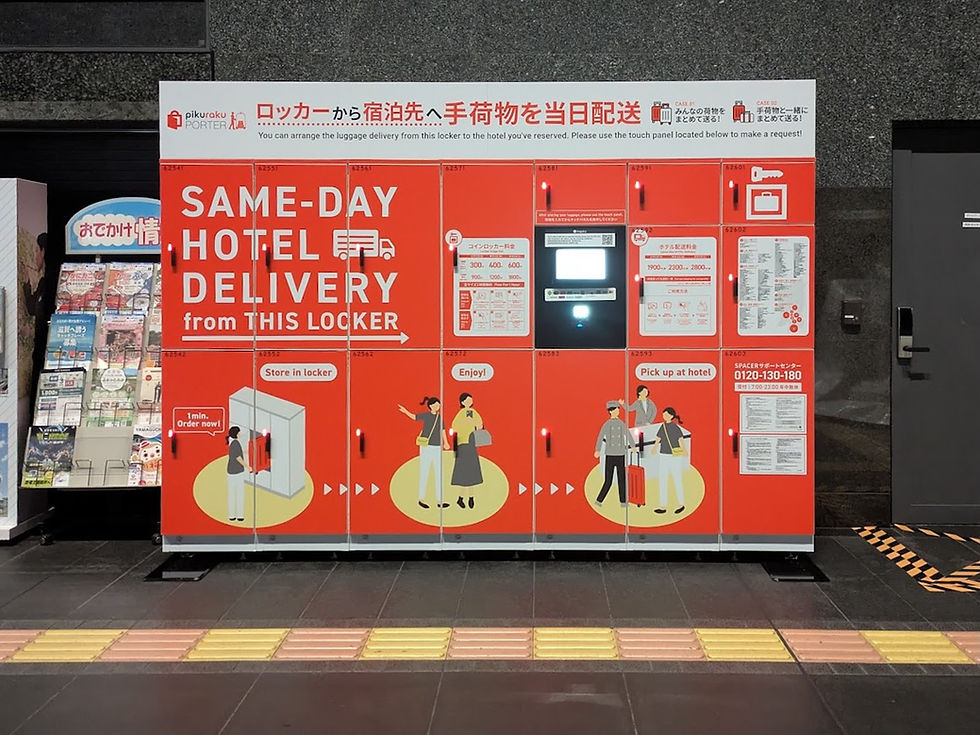
The lockers come in three sizes — large (fits a full-sized carry-on suitcase), medium (small carry bag), and small (everyday bags) — with pricing to match: ¥2,800 / ¥2,300 / ¥1,900. The same-day delivery cutoff is 2:00 PM, with delivery by early evening. You cannot specify an exact delivery time at the hotel, and the service notes that weather and traffic can occasionally affect timing.
The lockers are also available for standard temporary storage from 4:35 AM until the last train, with the first 60 minutes free. Rates run ¥300 / ¥400 / ¥600 per three-hour increment for small, medium, and large, with 24-hour maximums of ¥900 / ¥1,200 / ¥1,800. Even if you miss the delivery cutoff or simply don’t need hotel delivery, this is one of the more practical storage options in a station often short of available coin lockers during peak season.
We haven’t yet used Pikuraku PORTER ourselves — it launched in Kyoto in January 2026, new enough that it didn’t exist during our last family trip there. But if I were arriving with family, or traveling with more luggage than my usual carry-on, I would use it without a second thought. Kyoto’s narrow streets, crowded buses, and perpetually oversubscribed taxis make every large suitcase a logistical challenge. This new option solves it elegantly, in the way Japan so often solves logistical problems.

One practical note for Zen Gaijin readers: if you're staying at a boutique hotel or a small ryokan tucked into one of Kyoto's older neighborhoods — which is exactly where many of you are staying — confirm that your property is enrolled in the network before you commit. With approximately 280 participating hotels the coverage is substantial, but boutique and traditional properties don't always enroll. Check first at the Pikuraku PORTER Kyoto site.
The Osaka-Kyoto Connection
Here is one more angle worth flagging for multi-city travelers, because the FAQ on the Pikuraku PORTER site confirms it and almost no one is writing about it yet in English.
If your itinerary includes both Osaka and Kyoto, you can ship your luggage from Osaka station lockers directly to your Kyoto hotel. The service runs through Pikuraku PORTER Osaka — with lockers at JR West, Kintetsu, Hankyu, and LINKS Umeda stations — as well as KoKoHub locations operated by Osaka Metro. You check out of your Osaka hotel, drop your bags at the station, spend your last Osaka morning unencumbered, and have your luggage arrive at your Kyoto hotel that afternoon. No hauling suitcases onto the train. No navigating Kyoto Station at rush hour with a cartload of bags. Just the train, and then Kyoto, and then your luggage waiting at the front desk.

Airporter offers a competing option worth knowing about: hotel-to-hotel within Osaka/Kyoto — see pricing above. The Pikuraku locker system may be more economical if you can consolidate bags, since it charges per door rather than per piece. But Airporter delivers door-to-door without requiring you to find a locker location, which has its own convenience value. Know your situation and choose accordingly.
Because the Osaka Pikuraku service is new and expanding rapidly, if you want to use it, verify the locker locations and pricing before your trip.
A Premium Option for the Tokyo-Kyoto Corridor: Luggage Express
One more service is worth knowing about, with an important caveat on price. Luggage Express, launched in November 2025 by JTB and JR Central, does something no other service on this list can claim: it ships your bag between Tokyo and Kyoto on the Tokaido Shinkansen and delivers it to your hotel the same day. Drop your bag at a participating hotel front desk by 9:00 AM, or at a Kyoto or Tokyo Station counter by approximately 10:30 AM, and your luggage arrives at your destination hotel by 6:00 PM (Express plan) or 9:00 PM (Regular plan).
The price reflects the speed: ¥16,500 per piece for Express delivery, ¥13,200 for Regular. That is roughly two to four times the cost of Airporter's hotel-to-hotel service on the same corridor. For most travelers, Airporter's next-day hotel-to-hotel option at ¥4,000–6,000 per piece is the better value. But if you want a genuinely free last morning in Kyoto — a final temple, a long lunch in Gion — and your bags waiting at your Tokyo hotel when you arrive that evening, Luggage Express is the only service currently delivering that. Book online at luggage-express-service.com and confirm that your specific hotels are on the eligible list before committing. The service is new and the hotel network is still expanding.
So Which Service Is Right for You?
The best luggage strategy, if you can manage it, is not to need one. Traveling using only carry-on luggage has made our Japan trips dramatically more flexible — faster to transfers, easier ryokan arrivals, spontaneous itinerary changes that don't require elaborate logistics coordination. Japan rewards lighter travel in ways that are hard to overstate.
But lighter travel isn't always possible. Longer stays, family travel, multi-city itineraries with formal occasions — there are lots of reasons people travel with lots of luggage. When that's you, these services are genuinely excellent, provided you know the cutoffs and plan around them.

Quick Reference Summary
• Landing before noon at Haneda: all options available; Yamato if you’re very early, JAL ABC, Airporter, or ecbo/Keikyu for more flexibility
• Landing at Narita before noon: Airporter or JAL ABC
• Landing late morning to early afternoon at Haneda: JAL ABC, Airporter, or ecbo/Keikyu at standard pricing
• Landing mid-afternoon at Haneda: ecbo/Keikyu accepts until 4:00 PM with the ¥500 surcharge — still your best option if you’ve just missed the standard window
• Landing in the evening anywhere: plan for next-day delivery and adjust expectations accordingly
• Arriving by Shinkansen into Kyoto: Pikuraku PORTER at the Central Gate, full stop
• Multi-city Osaka + Kyoto itinerary: drop bags at Osaka Pikuraku lockers, collect them at your Kyoto hotel — or use Airporter hotel-to-hotel if locker logistics don’t suit
• Sending bags from Tokyo to Kyoto: Airporter hotel-to-hotel at ¥4,000–¥6,000 per piece
• Sending bags same-day Tokyo↔Kyoto, bags at your hotel by evening: Luggage Express at ¥13,200–16,500 per piece — premium pricing for a genuinely unique capability
• Last day in Tokyo, flying home from Haneda: drop your bags at ecbo cloak Marunouchi or Shimbashi and get your city back
The dream sold by most travel information resources — “land in Japan and your luggage magically appears at your hotel” — is real. It just has a curfew. And now you know exactly where that curfew is.


