_edited.png)
Tohoku Autumn Road Trip: Six Unexpected Moments in Northern Japan
- Zen Gaijin

- Jan 11
- 8 min read
From the power of plunging waterfalls to the hush of forest shrines, our autumn road trip through Tōhoku began with a quiet series of revelations. These six short vignettes capture the opening movements of a much longer journey — two weeks in autumn exploring one of Northern Japan’s least-traveled regions. This road trip was filled with serene onsen, sacred mountains, and slow journeys on country roads.
Some travel experiences reveal their essence all at once, announcing a dominant theme at the outset. They interpret subsequent events as variations on that theme. Other journeys unfold more slowly and unexpectedly. They gradually acquire form and meaning through cumulative elements — timing, pace, contrasts, and serendipity. On such journeys, experience unfolds incrementally — a series of unique moments, each one quietly preparing you for what comes next.
There is a third kind of knowing, too — the kind that only arrives after you've come home and set the journey down. What felt like a random constellation of choices while planning, and a series of vivid but separate moments while living, reveals itself in retrospect as something more coherent: a path that was always leading somewhere, even when you couldn't see it. The connections surface slowly, the way meaning does.
Our days on the road in Tōhoku took this slower, more cumulative form. Planned and unplanned experiences remained in constant delightful tension. Accordingly, the vignettes that follow are not simply a compendium of pre-planned stops but rather an amalgam of moments, each one shaping those that came after.
Our Tohoku Autumn Road Trip: How It Began
Akiu Ōtaki: The Melding of Power and Grace
The richest beauty is not just seen — it is felt.
Our Tōhoku adventure, planned in terms of visits to places we'd never been before, began with water.

After arriving in Sendai from Tokyo, our rental car took us directly westward toward Akiu, abruptly leaving all vestiges of the big city behind. The roads narrowed, the air cooled, and deeply forested hills moved to embrace me. Suddenly, we felt ourselves enveloped in a different world.

Our first aesthetic experience was at Akiu Great Falls in Taihaku-ku, Miyagi Prefecture. It is formally designated by the Japanese government as a Place of Scenic Beauty — a description that vastly understates the emotional impact that builds as you immerse yourself in the site’s sights and sounds. We progressed past the small parking lot, a modest visitor center, and a posted trail map. The path led through a Shinto shrine framed by a weathered stone torii gate and flanked by two imposing stone guardians.

The shrine itself is small but compelling, anchored by a fierce black-and-gold deity whose powerful presence feels primal, almost volcanic. We ventured further, aware of a deep rhythmic pounding echoing through the trees. Suddenly, it appeared: Akiu Ōtaki is a raging torrent leaping from the hillside and plunging 165 feet into a misty basin, framed by cliffs ablaze with color in autumn.

It is important to get up-close and personal. As we stood before Akiu Ōtaki, we were immersed in a multi-sensory experience — sight, sound, spray, vibration — aware that our hearts were pounding in counterpoint with the rush of the water. It was an intensely moving sensation. Now we understood — no, apprehended — why these falls rank among Japan’s most celebrated waterfalls.
And then…the trail took us unexpectedly back to the mundane. At the trail’s end, locals hawked bundles of glowing orange persimmons, and a nearby stand served Hokkaidō soft-serve ice cream, a dense, creamy, impossibly smooth confection, the first of many we would seek out as we traveled on Tōhoku.

Such counterpoint: quiet after thunder, sweetness after brutal force, calm after thrilling impact. These contrasts set the tone for our journey: a constant interplay of power and stillness, surprise and repose.
Awed and thrilled, we drove on to KAI Akiu.
KAI Akiu ― A Ryokan Where Nature Provides the Décor
Stillness framed as art, as peace.
KAI Akiu is not so much a hotel as an exercise in sensory restraint, in measured understatement.

Tucked into the hills above a steep valley carved by the Natori River, this striking ryokan is designed not to compete with nature but to frame it. The soaring, spartan interior architecture, hushed hallways, tatami underfoot, and, most of all, windows so expansive they render interior decoration unnecessary. The view outside does it all, says it all.
Our room opens to nature—and opens us to nature. An entire wall is a sweeping panorama, with a wall-to-wall window and a couch that runs its full length. It invites us to settle in, quiet our breathing, and let the autumn colors wash over us as we gaze across the valley and up the mountainside.

Dinner, served in a private room just for us, is a remarkable, precise kaiseki experience, a dance of astonishing, adventurous pairings that left us smiling at how successfully the chefs resolved culinary risks.

After dinner, we sit on a raised terrace, soothing tired legs in a hot spring foot bath. We honor the invitation to sit quietly, watch the shadows darken, and listen to the river’s rhythms. The next morning, we climb uphill in a long covered walkway and slip into the outdoor onsen, warm boulders providing a nook to sit, soothing vapors caressing skin.
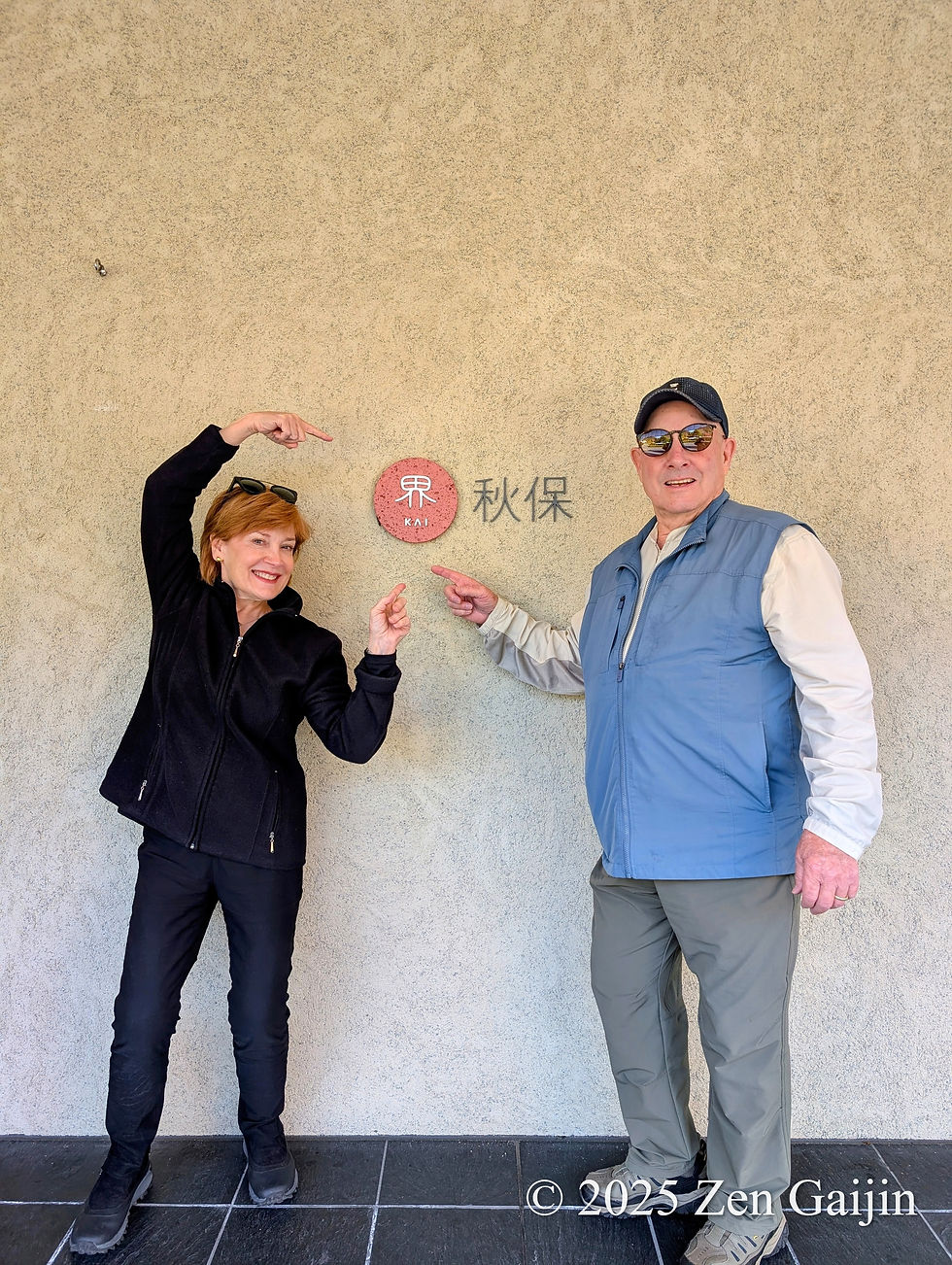
After the explosive beauty of Akiu Ōtaki, KAI Akiu is a trip to a completely different reality. If Akiu Ōtaki was crescendo, KAI Akiu was rest.
From KAI Akiu we would spend the next few days exploring the surrounding region — including a full day in nearby Sendai, the city Date Masamune built.
Naruko Gorge I ― A Frustrating Lesson in Standing Still
Sometimes the wisest move is the one you didn't plan.
Just this once, we said, we would tread the beaten path because Naruko Gorge, after all, is an absolute must-see, a fabled tourist attraction. Only on this day, we never saw it.
We left KAI Akiu early in crisp autumn air under flawless blue skies. The autumn foliage was at its absolute fiery peak. It was a Sunday; it was also a major Japanese holiday, Culture Day. Three kilometers from the gorge, traffic slowed…then stopped altogether. When they moved at all, the cars moved inches at a time. Time passed. More and more time passed until… we gave up.

Eventually, we admitted defeat and turned around. The lesson was clear: beauty draws a crowd, particularly on weekends in peak foliage season, particularly on national holidays. Another time, we told ourselves, another time. And never on Sunday.
___________________________________________________
A • Ra • Date ― Sweet and Sour at a Michi-no-Eki
Discernment is its own kind of travel skill.

All across Japan, travelers are treated to over 1,200 michi-no-eki, government-designated rest areas that offer local produce, souvenirs, specialty foods, and confections, often combined with funky parks and attractions. Often overlooked by Western tourists, these are not cookie-cutter oases along major highways; they are unique travel experiences.
Unique, we were about to learn, does not always mean excellent. We had eagerly anticipated this particular michi-no-eki. What we found defied description. The center resembled a crude cement fortress emblazoned with various garish signs and ringed by huge overcrowded parking lots. It was a chaotic, overcrowded zoo, plagued by some of the filthiest restrooms we've ever encountered in Japan.
Yes, here we did find the wondrous Royce chocolate, a Hokkaido luxury rarely seen this far south. But even Royce couldn’t sweeten this experience — one where it took forty-five minutes to edge past uniformed marshals waving batons at us as we fought to exit the parking lot.
Lesson learned: michi-no-eki discernment is essential on the road — if you don’t like what you see, drive on. There are far better ones down the road.
Naruko Gorge II― Second Time’s the Charm
The gorge was worth every minute of waiting — both times.

Days after our initial no-go Naruko Gorge misadventure, we tried again, arriving on a weekday morning before the day’s inevitable great rush. We made sure it was not a holiday of any kind. Sure enough, we found great parking, walked across the staggeringly beautiful bridge across the gorge — and waited for the show to begin.

Even the most brilliant foliage needs the right light to shine, so it does not automatically provide beautiful viewing. Not until the sun rises high enough for nature to turn the lights on. Our first photos were dull and uninspiring. Then, as if on a dimmer slowly turned, the color emerged in gradual stages — startling gold first, then copper, then scarlet sending fire up the lengths of soaring cliffs and then reaching down into the depths of the gorge below.

By midmorning, the dominant yellows had transformed Naruko Gorge into the spectacle we had envisioned all along. Now the moments were unfolding as they should. About the time we were sated and drove away to continue our Tōhoku road trip elsewhere, the parking lots again brimmed to overflowing, and lines of those waiting to park stretched far into the distance.
Another lesson: Naruko Gorge is intensely rewarding. But it doesn’t reward urgency. It rewards patience…and above all, it rewards timing.
Kinpo-jinja―Let Peace Descend As You Ascend
Some places do not find you. You must find them.

You will not stumble across this extraordinary 8th-century Shinto shrine by accident. It is a “hidden shrine,” a designated Akita prefecture natural monument that one must take pains to visit. Yet you cannot prepare yourself for what you will find when you eventually discover it nestled at the foot of a moss-covered mountain and the edge of a towering forest of 300-foot-tall Japanese cedars.

What you will discover — at the shrine's base, on its long moss-covered stairway, and at its Honden, its central structure and sanctuary, nestled high up the mountain — is surprise after surprise, a sequenced revelation of enormous power that unfolds in a series of increasingly serene sensory experiences.
After a nearly two-hour GPS-guided drive from Hiraizumi, we arrived at a simple parking area buried in the woods well off the road. The dense suginami forest hides a lichen-encrusted torii gate and a weathered enclosure with raw wood pavilions from the road, making it blend into the natural environment. We were led toward a ancient gate guarded by two enormous “devas,” giant guardian deities carved from cedar. As we passed through this gate, we discovered a long stairway leading upward to an unseen destination through the awe-inspiring columns of cedars.

As we climbed, we became cloaked in an overwhelming stillness. The shrine’s Honden (main sanctuary) gradually came into view, guarded by moss-covered statues and lanterns. Seldom used except for some training events and the annual August matsuri festival, this shrine welcomed me in while simultaneously leaving me alone…to savor, to contemplate. The shrine worships fourteen Shinto kami deities. In that stillness, their presence was unmistakable.
Here is the purest expression of Shinto: a profoundly moving meeting of nature and spirit, both a presence and an experience.

This is not an “attraction” that you rush to, hurriedly photograph, and rush away from. It forces you to slow down long before you arrive and rewards you with a spiritual stillness that lingers long after you depart.
We've only shown you the beginning.
These six vignettes trace the early days of our Tōhoku road trip — a sojourn that will go on to reveal even more wonders and insights. In the coming weeks, we will travel onward to places steeped in history like Hiraizumi and Mt. Haguro, soak in secluded onsens like Ganiba and Nyuto, and linger by the glassy waters of Lake Tazawa and Matsushima Bay. We'll share those stories with you — and describe the unforgettable meals and discoveries we found on day trips from Akiu, including Sendai. This is Tōhoku unfolding as we lived it — and as we are still coming to understand it.