_edited.png)
Tōhoku Japan: The North That's Still Waiting for You
- Zen Gaijin

- Dec 31, 2025
- 8 min read
Updated: Apr 16

While friends texted us photos of shoulder-to-shoulder crowds at Kyoto's Arashiyama, we stood completely alone at Takkoku Seikoji, watching autumn light filter through 1,200-year-old cedars onto a temple carved into a cliff face. Flanking us: a fifty-foot Buddha carved into the mountain a thousand years ago. Audience: zero other Western tourists.
Over twelve days traveling through Tohoku during peak autumn foliage season, we encountered exactly five Western tourists. Five. While Tokyo, Kyoto, and Osaka were jammed, we had Japan's most spectacular autumn landscapes essentially to ourselves.
Tohoku Japan: The Region Nobody Talks About
The Tohoku region of northern Japan (Honshu island) is notable for two reasons. First, it's almost unbelievably beautiful, distinguished by its rugged scenic countryside, rich traditional rural culture, and harsh winters. Second, although it boasts almost every charm Western travelers seek in Japan, you'll find almost no Western travelers there.
Anchored by the wonderful city of Sendai northeast of Tokyo, Tohoku ranges northward across six prefectures (Aomori, Akita, Iwate, Miyagi, Yamagata, and Fukushima), and stretches westward all the way to breathtaking mountain gorges near the Pacific coastline. In mid-to-late November, when autumn foliage explodes across its rugged mountains, the intensity of color rivals anything we've seen anywhere in the world.
What "No Crowds" Actually Means

Popular with Japanese domestic tourists but virtually unknown to Western visitors, Tohoku offers a trade-off: your translation app is going to get a workout. Even in premium ryokan and major attractions, English speakers are rare. But staff and citizens remain unfailingly polite and helpful — you'll just need patience and technology.
What we got in return during this peak autumn season: hiking mountain trails completely alone. Standing in temples without tour groups. Gorges savored in solitude. The kind of serene silence that makes experiences feel uniquely your own.
To be clear: we certainly weren't alone in Tohoku. Japanese tourists know where to find their country's most beautiful places, and they build much of their lives around traveling to see them. But visiting sites and sights in company with Japanese visitors is part of what makes Tohoku special. They admire beauty in respectful contemplation. They appreciate the deep cultural origins of Tohoku's places and spaces. Here you'll find no rushing tour groups with flags and loudspeakers, no jockeying for selfie positions, no crowds that prevent you from experiencing the breadth and depth of a space. Just people who understand what they're seeing, people savoring experience with respect.
And, not incidentally: these visitors take their photos and then get out of the way. No one blocks others from experiencing the space. When someone wants to photograph a particularly beautiful moment, others naturally step aside, wait their turn, then the photographer reciprocates. This isn't enforced by rules — it's simply how visitors have been taught to behave.
After returning to Japan's major cities and influencer-hyped tourist venues, one finds the contrast jarring and annoying: people blocking views indefinitely for elaborate photo setups, refusing to yield space, treating sacred sites as backdrops rather than destinations. Tohoku reminded us what travel photography used to be: capturing a moment, not performing one.
Sacred Solitude: What That Actually Feels Like
We deeply love Kyoto and have spent years exploring its temples and gardens. But the contrast with Tohoku was profound.
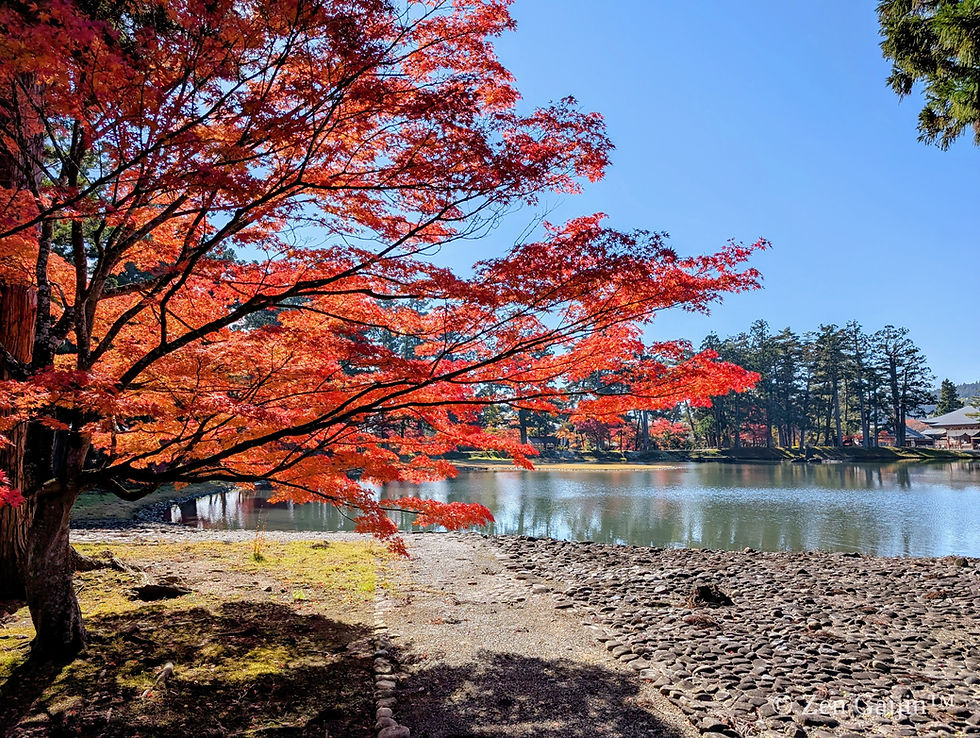
Tohoku so often captures the very soul of Shinto — the sacred meeting of nature and spirit. At the unique temple complex of Motsu-ji near Hiraizumi, for example, we strolled the pristine Pure Land gardens practically alone, and never encountered a single westerner. In November. During peak foliage season.

Later, a walk up a moss-covered mountain path through a cathedral of gigantic cedars at the Kinpo-jinja shrine proved the most extraordinary temple experience we've had in forty years of visiting Japan.

This is what "no crowds" actually means in Tohoku. Not just fewer people, but the space and pace to feel what these places were meant to convey.
Daily Doses of Serendipity
As experienced travelers, we thought we knew what to expect when heading to Tohoku. We'd done our homework, planned routes through all six prefectures, driven rural mountain roads elsewhere in Japan. What we got was example after example, surprise after surprise:
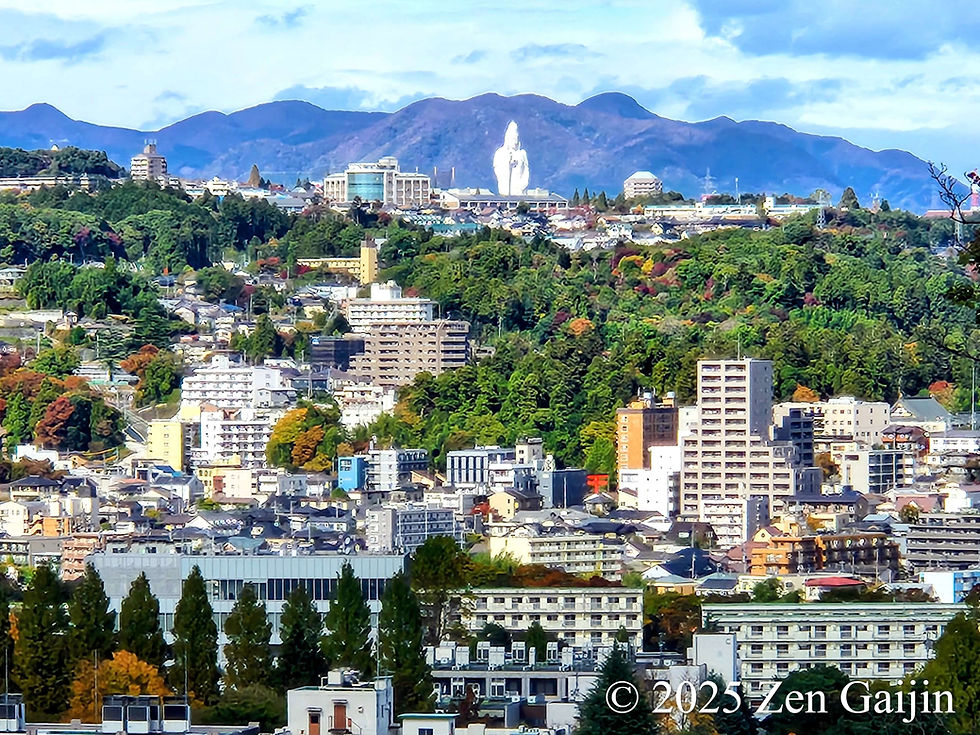
The gleaming white 330-foot bodhisattva Byakue Kannon towering on the horizon overlooking Sendai's skyline: We weren't expecting a giant Buddhist statue standing guard over a modern city, foreshadowing how Tohoku would keep surprising us like this: grand-scale experiences in unexpected places.
A truly outstanding cup of soft-serve ice cream sold next to the statue of famed samurai Date Masamune perched on his horse atop Aoba Castle ruins in Sendai, an experience that sums up Tohoku perfectly: a significant historical monument, spectacular city views, zero crowds, excellent snacks.
Matsushima Bay's serene majesty, a picturesque painterly landscape rendered in a rich palette of hues — one of Japan's "Three Most Scenic Views" — where we had the walking paths entirely to ourselves (and, of course, the bay's oysters were indescribably delicious).
A centuries-old shukubo (temple lodging) stay at Saikan, where Buddhist monks served us shojin ryori pescatarian cuisine of the highest caliber.
Dango (rice flour dumplings) flying across a gorge in a basket on a zipline while our national anthem played from the shop on the opposite cliff.
Three temples in Hiraizumi so stunning they changed how we think about Japanese temple architecture, all adjacent to a little town so pristine that it reminded us of a movie set.

This sums up Tohoku perfectly: significant historical monument, spectacular city views, zero crowds, excellent snacks. 
We weren't expecting a 330-foot Buddhist statue overlooking a modern city. Tohoku kept surprising us like this—grand scale in unexpected places.
Matsushima Bay's serene majesty (and its incredible oysters)

Tōhoku is not a consolation prize for travelers who couldn't get into Kyoto. It is a destination that rewards exactly the kind of traveler you've become — one who has moved past the famous and into the genuinely rare.
In the posts that follow, we'll take you deeper: into the streets of Sendai, through six unforgettable moments on the road north, and into Hiraizumi, a town that has been tending its extraordinary heritage for eight centuries and counting.
While everyone else fights for space in Kyoto, Tōhoku has autumn to itself. And now you can too.

Tōhoku, Unfolding
Tōhoku is not a destination you can cover in a single post — or a single trip. We've already taken you deeper into some of what makes this region extraordinary: into six unforgettable moments on the road north, into Hiraizumi, a town that has been tending its extraordinary heritage for eight centuries, and into the sacred gorges of Genbikei, where the water runs glacial blue and your lunch arrives by basket across a canyon.
More is coming: the streets of Sendai, the serenity of Matsushima Bay, the onsen depths of Nyuto, and the austere beauty of Lake Tazawa. Tōhoku unfolds slowly — and we're still finding the words for it.
These aren't "hidden gems" in the clickbait sense — they're the genuine cultural immersion that seasoned Japan travelers seek but struggle to find. This is rural Japan at its most authentic, accessible to anyone willing to venture three hours north of Tokyo.
Ready to start planning? Our guide for return travelers to Japan covers everything from budgeting and transportation to finding cultural experiences and understanding what you might have missed on your first visit.
Practical Planning Considerations
Tōhoku in Any Season
Autumn is Tōhoku's most dramatic season, when foliage blankets the mountains in color and the crowds that plague Kyoto simply don't materialize here. Mid-to-late November offers peak foliage; we visited November 14–26 and found perfect conditions throughout the region.
Spring brings spectacular cherry blossoms to certain areas, though Tōhoku is vast and not every corner is blossom country — the region rewards research before a spring visit. Summer offers something different: the higher elevations and northern prefectures provide genuine relief from the heat that makes July and August in Tokyo and Kyoto increasingly punishing.
Winter in Tōhoku is for the hardy and the prepared--and the devoted skier. The Shinkansen and major train lines run reliably, and most cities remain navigable, though travel times on public transportation may stretch a bit longer than in other seasons. If you're driving — which we recommend for experiencing Tōhoku's rural depth — the tollways and major highways are kept in good condition. The northernmost reaches of Aomori and Akita prefectures are a different matter: some roads close for the season entirely, so careful advance research is essential. Within those parameters, winter Tōhoku offers a vivid counterpoint: powerful winds, deep snow, austere mountain beauty, and onsen ryokan at their most elemental — the hot spring bath after a cold day in the mountains is one of travel's great sensory experiences.
For the first trip, autumn is the answer. But Tōhoku repays return visits in any season.
Planning Your Tōhoku Japan Travel: FAQs
When is the best time to visit Tōhoku? For a first trip, autumn is the best answer — but see the "Tōhoku in Any Season" section above for a full picture of what each season offers.
Is Tōhoku crowded during autumn? No. Despite being peak foliage season, we encountered only five Western tourists in 12 days of travel across six prefectures.
How far is Tōhoku from Tokyo? Just under two hours north of Tokyo by Shinkansen — Sendai is roughly 1 hour 40 minutes from Tokyo Station on the Hayabusa. For most travelers, that's closer than Kyoto.
Do people speak English in Tōhoku? English is less common than in Tokyo or Kyoto, but staff at major sites, hotels, and ryokan are accustomed to international travelers and have either English speakers or translation apps at the ready. Bring a translation app and expect unfailingly polite and patient service.
Do I need a car in Tōhoku? We strongly recommend a car for the deeper rural experiences. Cities like Sendai, Aomori, and Morioka are navigable by public transportation, but many of Tōhoku's most extraordinary places simply cannot be reached without one.
Can Tōhoku be combined with a broader Japan itinerary? Absolutely. Tōhoku's Shinkansen access makes it easy to combine with Tokyo, Nikko, or further south. It scales to whatever time you have — three days in Sendai and Matsushima, or three weeks across all six prefectures. Either way, it earns its place in any Japan itinerary.
How many days do you need in Tōhoku? Five days is a reasonable minimum to see the highlights — Sendai, Matsushima, and Hiraizumi can be covered in that time without feeling rushed. We spent twelve days and could have used more. Tōhoku is vast, varied, and stubbornly resistant to being hurried.
What's the best base city for a Tōhoku road trip? The obvious answer is Sendai, Tōhoku's largest city and its main Shinkansen gateway, and geographically it makes sense as an entry point. But here's what most travel guides won't tell you: Tōhoku is vast, and no single base city can serve the whole region. If you anchor yourself in Sendai, you simply cannot reach the extraordinary places further north — Lake Tazawa, the Nyuto onsen cluster, the mountains of Akita — without exhausting travel days that should be spent exploring.
The approach that worked for us: think in terms of itinerant bases rather than a single hub. Settle into one location for three or four days, explore everything within reach, then move on to a new base further along your route. We used the onsen village of Akiu, the island-dotted serenity of Matsushima Bay, and the quietly wonderful Nyuto Onsen as successive anchors — each one a destination in itself, each one opening up a different face of the region.
Plan your Tōhoku trip the way the region itself is built: in stages, moving north, with time to breathe at each stop.