
_edited.png)
Hiraizumi, Japan: The Town That Tends Its Dreams
- Zen Gaijin

- Apr 2
- 9 min read
Updated: May 4
Hiraizumi looks wrong.
Not wrong-bad — wrong-perfect. The roads are too smooth. The houses too tidy. The train station too charming, with its window boxes and its unhurried platform and, just steps away, a ramen shop so precisely what a ramen shop beside a train station should be that you half-expect a film crew to materialize from behind the maples. We kept saying it to each other, the entire first day, because it was the only way to account for what we were seeing: this looks like a movie set. A picture-perfect backlot, somewhere between a 1950s MGM production and a dream you’ve had about Japan that turned out, astonishingly, to be accurate.

It took us a little longer to understand what we were actually seeing. Hiraizumi has been tended. Not frozen in amber, not "museumified" behind velvet ropes — tended, the way you tend something you genuinely love, across centuries, because you understand its value even when the rest of the world has forgotten to look.
The rest of the world has, largely, forgotten to look. Which is precisely why you should go.
— ✦ —
A City Burned to the Ground — and Tended Back to Life
During the Heian Period (794–1185), Hiraizumi was nobody’s afterthought. "The northern branch of the Fujiwara clan, then the most powerful family in Japan, made it the rival capital to Kyoto — a city so historically significant that UNESCO designated Hiraizumi a World Heritage Site in 2011 — a glittering Buddhist paradise of temples, gardens, and political ambition, a city that dared to suggest that such beauty could be made permanent.
It could not. In 1189, Minamoto Yoritomo — on the path to becoming Japan’s first shogun, hunting his brother and rival Yoshitsune, who had taken refuge with the Fujiwara — razed the city. Hiraizumi never recovered its prominence. Today its population hovers around 7,500. A few cabs sit parked across from the train station, looking as though they’re waiting for rush hour in a town that never seems to rush.
Five hundred years after the burning, Matsuo Bashō — the greatest poet of Japan’s Edo period — made a pilgrimage north to stand in the ruins. He was moved to tears. He recorded the moment in what has since become one of the most celebrated haiku in the Japanese language:
Natsu kusa ya
Tsuwamonodomo ga
Yume no ato
Summer grasses —
All that remains
Of warriors’ dreams.
We came in autumn, not summer, but Bashō’s words followed us through every hour we spent in Hiraizumi. They are the key to the place.
— ✦ —
Strange Lodging, Excellent Food
We stayed two nights at the Musashibou Ryokan — a sprawling, once-grand facility that has known better decades. Several of its wings are closed and walled off now. The rugs are threadbare in places, the sliding doors of the rooms showing their age, the onsen walls chalked and in need of attention. We were prepared to be disappointed.
Instead, we found something oddly moving. The staff were gracious in a way that felt less like hospitality training and more like genuine pride in what they still had to offer. The food arrived in the measured, unhurried courses that are one of the great arguments for ryokan travel — each dish asking you to slow down, pay attention, be present. It was uniformly excellent: the kind of cooking that makes you understand why people drive hours into rural Tōhoku.
Musashibou is itself a study in tending. It is imperfect, and it is cared for, and somehow the combination produces something warmer than a polished hotel ever could.


— ✦ —
The First Delight: Motsu-ji, Where Paradise Was Planted
A short walk downhill from the ryokan brought us to our first destination, and we had made a deliberate choice to start here. Motsu-ji is a Pure Land Buddhist garden — which is to say, a human attempt to recreate paradise on earth — and beginning here, before the temples, felt right. You need to understand what the Fujiwara were reaching for before you can fully appreciate what they built.

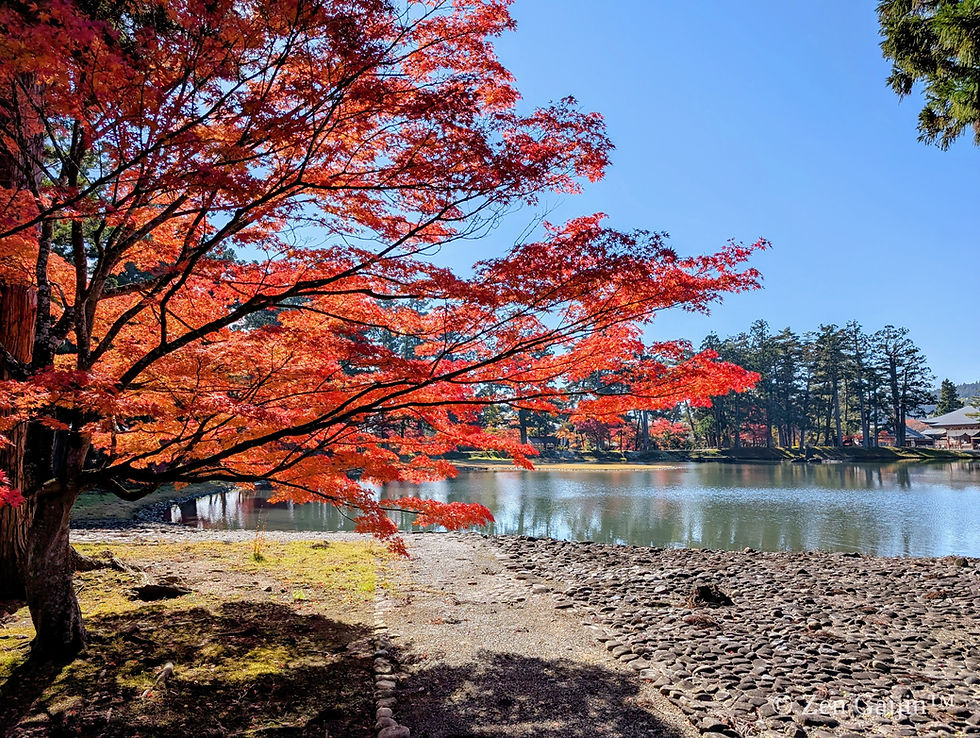
What they built, in the twelfth century, was extraordinary. What remains is still extraordinary — a vast, serene landscape of interconnected ponds, precise landscaping, and artifacts shaped by both skilled hands and the long erosion of time: fractured stone faces, weathered statues, remnant temple foundations scattered across the grounds like punctuation in a very old sentence. In autumn, the maples were deep in their annual extravagance, going gold and scarlet and a shade of burnt orange that has no name in English. The whole garden was half-submerged in fallen leaves.

And there, near the edge of one of the ponds, we found it: a weathered stone inscribed with Bashō’s haiku. The same words. This place, or close to it.
We stood there for a while without speaking.


It was at Motsu-ji that the movie-set feeling finally resolved into something we could articulate. Hiraizumi doesn’t look perfect because it’s artificial. It looks perfect because it has been loved — by people who understood, perhaps more clearly than most, that nothing lasts, and that this is exactly why you tend it. The Pure Land garden and the immaculate town are the same gesture, repeated across eight centuries.


— ✦ —
Act Two: Something Completely Different — Takkoku no Iwaya
If Motsu-ji represents Hiraizumi’s serene, horizontal beauty, Takkoku no Iwaya is its vertical, vertiginous counterpart — and the contrast could not be more dramatic.

A short drive from town, the Takkoku no Iwaya complex centers on Bishamondō, a temple built into the face of a cliff. Not beside it, not below it — into it, its vermilion facade emerging from the rock as though the mountain agreed to become architecture.

The story behind it is equally striking: in 801, the warrior Sakanoue no Tamuramaro defeated the warlord Akurō Takamaro, whose particular infamy was stealing women and children from the local people. In gratitude to Bishamon, the god of war, Tamuramaro had the temple built with 108 Bishamon statues and dedicated it as a place to pray for peace. In its deepest recesses stands a statue of the Buddha, said to have been carved by the monk Jikaku Daishi during the Heian era.
The temple has burned down three times — in 1490, 1615, and 1946 — and been rebuilt each time. Today it cries out again for restoration; rot is advancing on the support pillars and ornamental work. But standing before it in the autumn light, its colors blazing against the cliff face, you feel the stubborn persistence of the thing. It insists on existing. It has always insisted on existing.

Adjacent to Bishamondō, carved into the same sandstone cliff, is the Ganmen Daibutsu — the Northern Rock Buddha, a fifty-foot figure that was originally a full seated Buddha before an 1896 earthquake destroyed the lower half. Legend attributes its creation to Minamoto no Yoshiie, who supposedly carved it by firing arrows at the cliff face, which is either the most implausible story in Japanese art history or the most entertaining. The upper portion that remains is powerful even in its incompleteness — the face still emerging from the stone, patient and eroded, still being tended against the weather.

When we were there, we counted perhaps five other visitors. Five, in peak fall season. The silence was immense and generative. Had this temple been located anywhere near Kyoto, you would be standing in a queue for two hours, photographing the back of someone else’s jacket. Instead, we had the cliff and the maples and the watching Buddha nearly to ourselves.
We took our time.

— ✦ —
The Pièce de Résistance: Chuson-ji
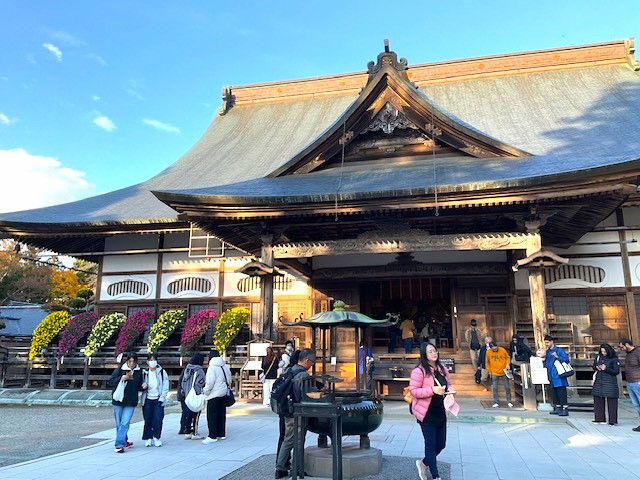
We had been building toward Chuson-ji deliberately — Motsu-ji first, then Takkoku, saving the great complex for last. The sequence was intentional: Pure Land garden to cliff-face temple to this, the culmination. By the time we climbed the long, steep hill through the cedar forest to reach Chuson-ji’s main gate, we understood the emotional register Hiraizumi demanded. We were ready.

Established in 850 as a Tendai Buddhist temple, Chuson-ji came to extraordinary prominence when the northern Fujiwara made it the spiritual center of their ambitions. The first Ōshū Fujiwara lord, Kiyohira, began construction of a massive complex early in the twelfth century — more than forty halls and pagodas, over three hundred monks’ residences. In the temple’s dedication pledge, the Ganmon, Kiyohira wrote that all travelers, regardless of status, would be greeted with affection by the Buddhas and receive their blessings without fail. It is a remarkably democratic sentiment for a twelfth-century warlord.
Fire took most of it in 1337. What survived — more than three thousand National Treasures and Important Cultural Properties — was enough to be staggering: lacquerwork, metalwork, calligraphy, Buddhist statues, sutras, and the burial accoutrements of the Fujiwara lords themselves. The Sankōzō Museum, opened in 2000, now houses most of these treasures. Allow time for it; the depth of craft on display will stop you cold.
But none of it quite prepares you for the Konjikido.
Built in 1124 and miraculously intact — one of only two structures from the original Fujiwara complex to survive — the Konjikido is a hall covered entirely in gold leaf. Floor to ceiling, inside and out, every surface shimmering. It stands today inside a protective building, which means you approach it in stages: through a door, then another door, then suddenly the gold is in front of you, small and blazing and somehow both intimate and overwhelming. The hall contains the mummified remains of three generations of Fujiwara lords beneath its central altar, which makes its glittering excess feel less like vanity and more like defiance — a refusal to be forgotten, pressed into gold and persisting across nine centuries.
Photography is forbidden inside. This turns out to be a gift. Without a lens between you and it, you have no choice but to actually look.

A practical note: Chuson-ji is spread across a long, steep hill — its many halls, museums, restaurants, and souvenir shops distributed across varied terrain. Enter through the main gate and expect to be thoroughly leg-weary by the time you finish. You will be glad anyway.

— ✦ —
Bashō wept when he stood in Hiraizumi’s ruins and thought about what had been lost. We understood, by the end of our two days, that he was also weeping for a particular kind of beauty — the beauty of things that survive not through luck or armor, but through the devotion of people who keep showing up to tend them.
The summer grasses grow, and are tended, and grow again.
Go.
— ✦ —
Planning to Go to Hiraizumi
Getting there: Hiraizumi is served by the JR Tōhoku Main Line; the station is small, charming, and perfectly functional. By car, it’s accessible from the Tōhoku Expressway and makes an ideal anchor for a Tōhoku road trip.
How long to stay: Two nights minimum. One night is not enough to give Chuson-ji, Motsu-ji, and Takkoku no Iwaya the time they deserve.
When to go: Autumn is magnificent — the foliage peaks in late October to early November. But Hiraizumi’s beauty is architectural and botanical in equal measure; it rewards visits in any season.
The ramen: The restaurant fronting the traffic circle at the train station. Don’t skip it. It is, improbably, one of the best bowls of ramen we’ve had in Japan — which is saying something — and it costs almost nothing. Go for lunch before you start your temple circuit. You’ll walk better for it.
Day trips: The gorges at Genbikei and Geibikei are both within easy reach and deserve their own afternoons — and their own stories, which we’ve given them separately on Zen Gaijin.
— ✦ —
The initial photo is ©Kaedeenari | Dreamstime.com. All other photographs ©Pamela Woldow and Douglas Richardson / Zen Gaijin™. All rights reserved.


