
_edited.png)
Part 3: Yamaguchi Prefecture Should Be High on Your Japan Travel List
- By Zen Gaijin

- Jan 15, 2025
- 5 min read
Updated: Mar 22
Beneath the Surface: Crystal Springs, Massive Caves & 350 Million Years of Geological Wonder
Looking for the beginning of this journey? Start with Part 1, then continue with Part 2 before diving into Part 3 below.
Our final three Yamaguchi hidden spots all owe their existence (and notoriety) to limestone—and what happens when you submerge it in sea water and rain for 350 million years.
The vast Akiyodashai Plateau north of Mine City was once a coral reef, and its gradual erosion and dissolution created what is called karst topography—limestone pinnacles and poljes (features that appear above ground), sinkholes (land depressions that often form into lakes or ponds), springs, disappearing streams, and caves.
The most notable of these is the largest cave in Japan, the ten-kilometer-long Akiyoshido Cave that runs underground beneath the Akiyoshidai Plateau.
Karst topography is formed when water falling on the surface enters subsurface cracks and fractures in the bedrock, becomes acidic as it absorbs carbon dioxide from the atmosphere, passes through the soil, and then dissolves the calcite in the bedrock, creating larger openings and passages. The next thing you know, 350 million years have passed, and you’ve got a giant cave.
✨ A Pond Born of Prophecy: Beppu Benten Pond

The cobalt-blue waters of Beppu Benten Pond are as legendary as they are beautiful—fed by spring water and steeped in centuries-old folklore.
You’ll also find springs boasting water of stunning clarity and purity, notably Beppu Benten Pond located about thirty miles south of Motonosumi Inari Shrine and a twenty-minute drive from Mine City. It releases 55,000 tons of water daily.
Many locals happily draw their drinking water supply from the four-meter-deep pond, whose striking cobalt blue water remains a constant 14°C year-round and also is used for irrigation and an on-premises trout farm.
The pond is located in the compound of Beppu Itsukushima Shintō Shrine. Visiting the pond will be a short but worthwhile stop for you.
According to legend, following a prophecy in a dream, a chief of a local clan had cultivated the land which was suffering from a water shortage. Another prophecy then told him to enshrine the goddess Benzaiten. As soon as he did so, copious water suddenly began to spring out. Since then, the local community has dedicated a dancing ceremony every autumn to give thanks for the blessing.
🍽️ A Spring-Fed Culinary Stop
If you visit the pond around lunchtime, consider stopping by Benten Kaikan, a charming nearby restaurant known for its delicious rainbow trout dishes. The trout are raised in pristine spring water sourced directly from the pond and are freshly caught at the trout farm located right near it.

You also can order set meals or a la carte items like udon and karaage, if fish is not your favorite.
Address: Mizukami, Beppu, Shūhō-chō, Mine-shi, Yamaguchi Prefecture
Hours:
Pond open 24 hours; accessible year-round.
Benten Kaikan open 9:00 AM to 5:00 PM, closed Tuesday and Wednesday
🕳️ Akiyoshido Cave and Akiyoshidai Plateau
Your next stop, Akiyoshido Cave, lies about 100 meters beneath the Akiyoshidai Plateau and stretches approximately ten kilometers, with one kilometer open to visitors. This awe-inspiring natural wonder, which maintains a pleasant temperature of 17°C year-round, is both spacious and easy to explore, thanks to its well-paved paths, carefully crafted steps, and dramatic lighting that enhances its mystical atmosphere.

🧵 Inside the Cave
Inside, you’ll encounter a stunning array of geological formations, from terraces filled with cobalt-blue water to underground waterfalls and cathedral-like limestone towers.
The cave’s ceiling drips with eerie, grotesque formations that add to its otherworldly beauty. A large underground lake accompanies you along the walkway, its waters feeding into a cascading waterfall that greets you at the cave’s western entrance.


🌪️ Formations to Watch For
Highlights include the vast expanse of the "Blue Ceiling," the intricate travertine terrace known as "Hundred Plates" (resembling over 500 stacked dishes), and the magnificent "Golden Pillar," a travertine formation created over tens of thousands of years. Standing approximately 15 meters (49 feet) tall, it’s a breathtaking sight that showcases the power of nature and time.


⬆️ Elevator to the Plateau
When you reach the middle of your cave walk, if you wish, you can take a break and go directly up to the Akiyoshidai Plateau in an elevator. After you have climbed 20 meters to reach the elevator entrance, the long ride rises 80 meters to reach the surface. You can watch your progress toward the surface on the overhead elevator position indicator.
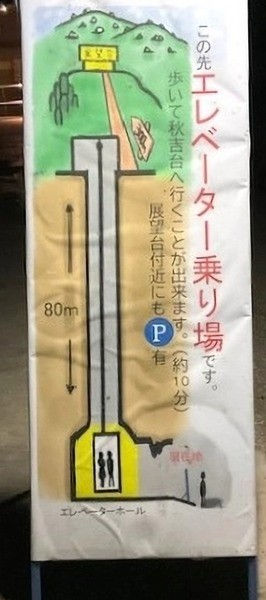
Tourists and nature lovers can enjoy the Akiyoshidai Plateau in every season: walking, running, botanical observation, star watching, and guided tours. Or just chilling in the Cafe Karstar at the observatory while enjoying the scenery. Most visitors then take the elevator back down to resume their trek to the cave’s east end, reached while traversing a lengthy mural depicting 350 million years of history—including modern recreational vehicles!

The cave has two main entrances, the Akiyoshido entrance near the bus station (with its rather down-at-heel collection of snack and curio shops), or the Kurpotani entrance at the cave’s east end, which you reach as you leave the cave at the end of a long, colorful mural depicting the history of the site. If you don’t wish to double back (and re-walk the 1 kilometer) to your original starting point at the Akiyoshido entrance, taxis are available at Kurpotani to take you back.

🚌 Getting Around Without a Car
If you’re not driving, JR Bus operates buses between Yamaguchi Station and Akiyoshido station every two-to-four hours, and Bochu Bus operates buses from Shin-Yamaguchi station. Bochu Bus also operates buses from Hagi, but they are infrequent and JR passes are not accepted.
Address: 3506-2 Akiyoshi, Shūhō-chō, Mine-shi 754-0511
Hours:
March to November: 8:30 AM to 5:30 PM
December to February: 8:30 AM to 4:30 PM
© 2025 Zen Gaijin. This content is original research and may not be reproduced without permission.


